en
The cold outreach market is crowded with software and every vendor claims to be the one that will fill your pipeline. But, as you may know, no single tool does it all and the right stack depends on what you are trying to achieve. Below is our selection of the tools that genuinely earn their place, the ones we rely on daily to turn a cold market into qualified meetings.
Talk to our experts →


• A cold outreach stack is built in layers: data sourcing, email finding and enrichment, sending and sequencing, plus automation and AI on top.
• Data quality is the single biggest driver of success, well ahead of clever copy or the sending tool itself.
• Our go-to selection includes Clay, LinkedIn Sales Navigator, Prospeo, lemlist, Instantly, n8n and Claude.
• The best tool is not the most feature-rich, but the one that matches your volume, your channels and your stage, and that your team will actually use.
For B2B prospecting, LinkedIn Sales Navigator is a reference. Its advanced filters let you isolate the exact decision-makers you want to reach, follow their moves and build highly targeted lists based on role, industry, company size or recent changes. It is less a sending tool than a precision source of profiles and it sits at the foundation of most outbound databases, feeding the enrichment and sending tools further down the stack.
Apollo is a strong all-in-one entry point that combines a vast B2B contact database with built-in sequencing. In a single platform you can search for prospects, pull their contact details and launch a first outreach sequence, which makes it a practical choice for teams that want to start quickly without assembling several tools at once. We often see it as a sensible first rung before a stack grows more specialized.
Ocean.io works at the account level. Starting from your best existing customers, it helps you find lookalike companies that share the same characteristics, which is an efficient way to map your total addressable market rather than hunting for accounts one by one. It answers the first question of any campaign: which companies are genuinely worth reaching in the first place.
PhantomBuster is the automation tool for collecting data that databases do not readily surface. It extracts profiles and information from LinkedIn and other public sources, letting you build lists from the exact places your prospects already are. Used with care, it turns manual copy-pasting into an automated sourcing step, the starting point for a scalable database.
Clay has become the data backbone of modern outbound. It lets you build and enrich prospect lists by drawing on dozens of data providers at once, falling back from one source to the next until it finds the information you need. Combined with its built-in AI, it turns a raw list of companies into a qualified, enriched database ready to be worked. Sophisticated teams run it at the centre of their stack, and we use it to give each campaign a solid foundation rather than an approximate list.
Trigify brings the third kind of raw material into play: signals. It tracks the activity and engagement that reveal when a prospect is moving, so you can reach out at the moment a need appears rather than at random. It works hand in hand with other signal sources, from hiring posts on LinkedIn Jobs, Indeed and Welcome to the Jungle, which often betray an internal pain point, to funding and company data on Crunchbase. A company recruiting for a role your solution supports is a far warmer target than a name pulled from a static list.
Once the database is built, lemlist is one of the strongest tools for turning it into conversations. It weaves email, LinkedIn and calls into a single coordinated multichannel flow, and it is known for personalization features that help each message feel written for its recipient rather than blasted to a list, with warm-up to protect deliverability along the way. We work with lemlist as a partner and use it regularly to orchestrate campaigns that keep a human touch at scale.
Audit of your GTM →It would be a mistake to think cold outreach is only a matter of writing good emails. The reality is that your results are decided long before the first message goes out, in the quality of your data and the reliability of your infrastructure. A perfectly written email sent to a stale address or caught by a spam filter produces nothing. This is why tooling matters so much: it governs whether your effort ever reaches a human being.


Seen this way, a good stack works in layers that each solve a distinct problem. Sourcing tools find the right accounts and contacts. Enrichment and verification tools make sure the data is accurate and complete. Sending platforms handle sequencing, timing and deliverability. Automation and AI tie everything together and remove the manual drudgery that slows teams down. Weakness in any one layer undermines all the others, which is why the best operators think in terms of a system rather than a single favorite app.
For all the talk of stacks, it is easy to fall into the opposite trap and buy fifteen tools where two would do. More software does not mean more results. A solo founder sending a few dozen highly targeted messages a week has very different needs from an agency running thousands of sends across many domains, and the right tooling looks nothing alike in the two cases.
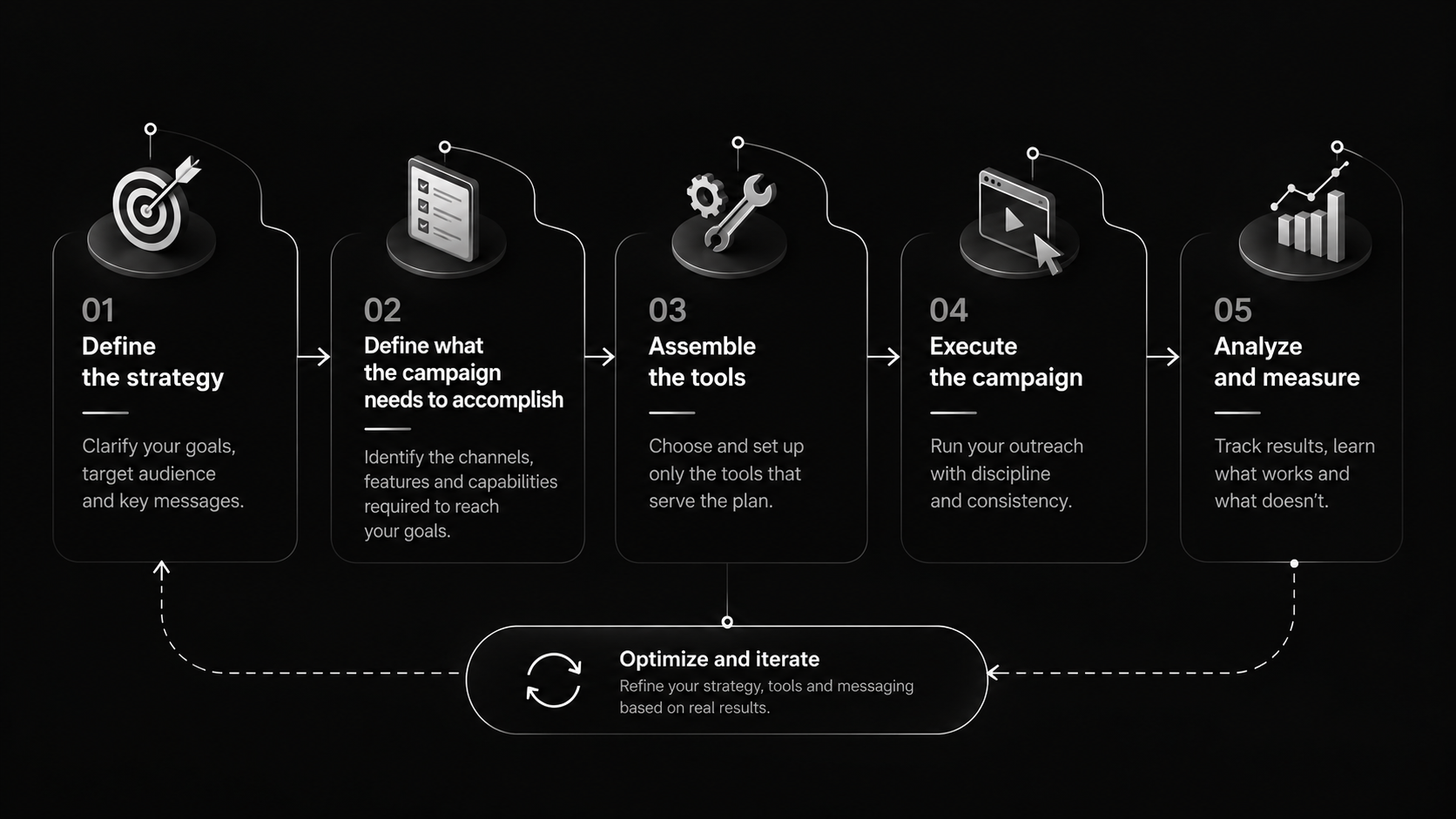
The honest answer is that the best cold outreach tool is the one that fits your volume, your channels and your maturity, and that your team will actually use day after day. A powerful platform left half-configured is worth less than a modest one used with discipline. This is also why we never start from the tool. We start from the strategy, define what the campaign needs to accomplish, and only then assemble the tools that serve it. The software follows the plan, never the reverse.
Choosing the right tools is one thing, assembling them into a system that reliably books meetings is another. If you want to move past piecing software together and build an acquisition engine that actually runs, we can help. We offer a thirty-minute conversation with our experts to look at your current setup, see which tools truly fit your goals and show you how they connect into a working whole. You leave with a clear view either way. Get in touch and let us talk it through.
[FAQ]
They are related but not identical. Sales operations and RevOps focus largely on supporting and optimizing existing processes, reporting and tooling across the revenue team. GTM engineering is more hands-on in building the acquisition system itself, designing the data flows, automations and AI-driven steps that generate opportunities.
A GTM engineer blends commercial understanding with data literacy, comfort with automation and no-code tools, and the judgment to use artificial intelligence well.
Not personally. The whole point of the discipline is that specialists build and maintain the system so you do not have to.